
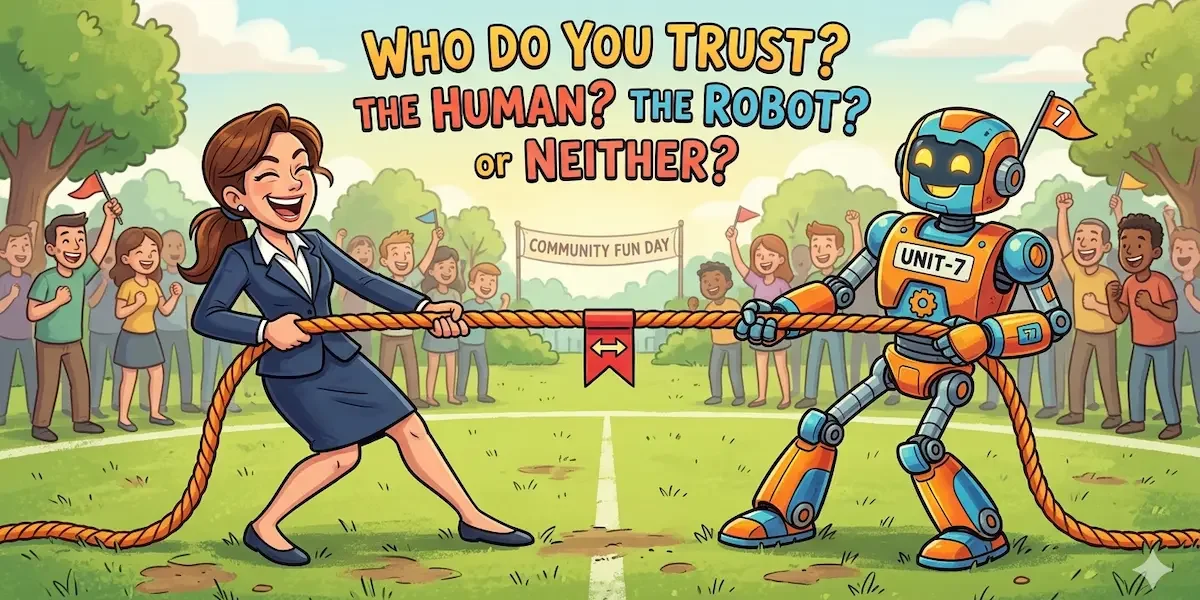
If You Don't Trust Your Frontline People to Do the Right Thing, How Will You Trust Your Agentic AI?
By Andy Sheats | Executive Coach to CIOs and CTOs | ctocoach.com.au
Trust is the organisational precondition for agentic AI. Most Australian companies aren't there yet.
Here's a simple test.
When was the last time you gave your contact centre agent your credit card and said: just do the right thing with it?
Most large Australian organisations — and virtually all of the ASX 50 to ASX 100 — don't work that way. Decision-making flows from the top. Frontline staff follow process. We bury trust under top-down directives, ass-covering policies, and a conservatism that mistakes control for safety.
That's fine. Until you want agentic AI.
Agentic AI Requires Exactly What You've Spent Decades Avoiding
Agentic AI — AI that doesn't just answer questions but takes actions and makes decisions autonomously on behalf of your organisation — requires the same thing that giving your contact centre agent your credit card requires.
Trust.
Not blind trust. But a genuine organisational belief that an autonomous actor — human or AI — can be given a goal, a set of values, and the authority to act, and will do the right thing.
If your organisation hasn't built that culture with its people, it hasn't built the precondition for agentic AI to work. At some point, an agentic system will encounter a situation that requires a judgement call — a customer edge case, an ambiguous instruction, a decision that requires discretion rather than compliance. The organisation will either trust it to act or it won't.
Most won't. Because most never have.
And the workaround most will reach for — scripting every decision path, building approval gates into every workflow, requiring human sign-off at every meaningful juncture — isn't agentic AI. That's just automation with better marketing. If you have to micromanage your agentic AI, you've missed the point of it entirely.
This Isn't a Technology Problem
The conversation in most boardrooms treats agentic AI as a technology question. Which platforms. Which models. What's the roadmap.
Those are real questions. But they're the wrong starting point.
The more important question is: what kind of organisation are we? Do we delegate real decision-making to the people closest to the customer and the work? Or do we centralise control, manage by process, and treat deviation from procedure as risk?
You cannot bolt autonomous decision-making onto a command-and-control organisation and expect it to work. The culture is the infrastructure.
What This Means for CIOs
The technical implementation of agentic AI is solvable. The organisational readiness question is harder, slower, and more politically complex.
The CIOs who will lead this transition successfully are not the ones with the best technology strategy. They're the ones who can hold the harder conversation at the executive table — about the kind of organisation you are building, how much you trust the people and systems that act on your behalf, and whether your culture is actually ready for autonomous action.
That's a leadership question. Not a technology one.
If you're serious about getting to agentic AI — maybe building trust in your people is iteration one.
If this is a conversation you're navigating, I'm happy to talk.
About Andy Sheats
Andy Sheats coaches CIOs, CTOs, and senior technology leaders. He has led digital businesses for 30 years as CEO, founder, CTO, investor, and director.
As CTO at Open Universities Australia he modernised engineering culture and doubled team throughput. As CEO and co-founder of health.com.au he raised $85m, grew to $120m in revenue, and was named Growth CEO of the Year by AVCAL. At REA Group he led global strategy through mergers and acquisitions, growing shareholder value by 10x.
Andy holds an MBA from Melbourne Business School, a Graduate Diploma from AICD, and is an accredited Leadership Circle Profile practitioner. He limits his practice to six clients at any one time.
Read Andy's full story → | CIO Coaching → | Book a discovery call →