
Executive Coaching and Mentoring for CIOs, CTOs and Technology Leaders
Leadership is a System and Process that you can Learn
To me, leadership means working with and through people to achieve meaningful outcomes—specifically, outcomes they wouldn't reach alone. Leadership isn't a vague "vibe" or an innate trait; it is a system that can be learned and, over time, mastered. It isn’t about personal achievement or being the smartest person in the room—we rarely are. It’s about creating the conditions that help others to succeed.
What Clients Are Saying: “elevating leadership game to a much higher level”
“Over the past 18 months, Andy has coached me to success as Alinta's CIO - guiding me on how to lead my teams, influence and collaborate with my peer Executives, contribute as part of an executive team, and work more effectively with our Board. Andy's "Leadership MRI" provided me with a wealth of information and insight into specific areas I needed to develop to lead more effectively … I'd recommend Andy as a coach to new and emerging CIOs and CTOs, as well as to experienced CIOs who want to elevate their leadership game to a much higher level.”
Nick Smith - CIO @ Alinta Energy

A Methodology Rooted in Stakeholder Centered Leadership
My approach is built on the work of Peter Drucker (the father of modern management) and his influence on Marshall Goldsmith (the world’s most renowned executive coach). Goldsmith developed Stakeholder Centred Leadership around the insight that leadership effectiveness is best measured by those who are impacted by it — our leadership is defined by their experience of our leadership, and what it can help them accomplish. In short, it’s not about us.
I utilise Stakeholder Centred Leadership (SCL) because it provides a rigorous, results-oriented structure for executive growth.
What it Stakeholder Centred Leadership?
A high-accountability growth model where your success is measured by the success of your key stakeholders and your organization. In SCL, the primary beneficiary isn't just you—it is the teams and the enterprise you lead.
Why I use it
CIOs and CTOs operate in complex ecosystems where traditional models often overlook the nuances of stakeholder management for CIOs. SCL provides a transparent, data-driven feedback loop to ensure your leadership evolution is visible, validated, and aligned with the strategic expectations of your CEO, the Board, and the business.
CIOs and CTOs don't "lead the technology"; we lead the people who deliver through technology.
A 6-Stage Coaching Framework for CIO and CTO Leadership Development
My structured 6-stage coaching and mentoring process helps CTOs and CIOs bridge the gap between Operational Competence (getting the work done) and Strategic Influence (shaping the future of the firm and its people). Grounded in extensive digital business experience, this process is designed to help technology leaders increase self-awareness, overcome limitations, and unlock their potential by designing the culture, systems, and organisation that empower others to grow.
In my experience, almost all CTOs and CIOs can become significantly more effective leaders within six months. Mastery is a longer journey of continual iteration toward becoming the person your organisation and teams need you to be.
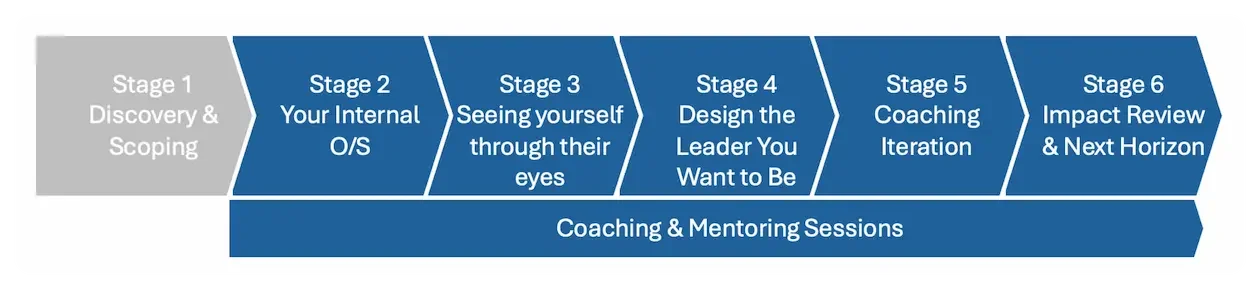
Typical CIO & CTO Coaching Engagement
-
A focused no-cost conversation:
Clarify your technology leadership priorities and key challenges
Map critical growth levers in your CTO, CIO role and team
Confirm that we have good chemistry and that there is a strong fit
This session provides clarity and ensures any CIO coaching engagement is high-impact. Based on this, I would prepare a formal proposal.
-
Identify your going-in assumptions, beliefs, behaviours and values that drive your technology leadership — this is your current leadership operating system. We all have one programmed into us.
Internal motivations
Values and beliefs that drive the day-to day
Default leadership patterns
Strengths to leverage
Blind spots that may limit impact
Career expectations as a CTO, CIO or Technology Leader
This is “why we do what we do”.
-
Self-awareness is the “starting line” leadership development. We will measure how others perceive your leadership and how that aligns with your own perspective. There is almost always a gap – that is where we work, to close that gap.
I use an assessment that I call the Leadership MRI, based largely on the Leadership Circle Profile. The LCP is a highly validated instrument that measures leadership competencies across 29 dimensions and across the range of cohorts we work with—for CTO and CIO roles, this typically includes the CEO, board, executive team peers, direct reports, their reports, and stakeholders.
My CTO and CIO clients say that the data and insights uncovered through the MRI are a game-changer in their leadership development.
More details about the Leadership Circle Profile for tech leaders are here.
-
Define the future-state leader you want to be and co-create a coaching and mentoring plan aligned to your role, objectives, and the organisation’s priorities. This plan will include specific outcomes and success measures.
This stage converts insight into action — mapping the capabilities, behaviours, and outcomes that will deliver measurable impact.
We would typically review the CTO Coaching and Mentoring Plan with your CEO (or other manager) to ensure alignment on development objectives and outcomes that will drive value for the organisation. There is typically an intersection of “what I want to be” and “what the company needs me to be”
-
Coaching and mentoring began with our very first session when we started the journey with a discussion of your "Leadership O/S." By this point, we will have a comprehensive view of the leader you are today and the leader you need to become to bridge the gaps.
We will have validated these priorities with your CEO or direct leader and articulated key outcomes in your Coaching and Mentoring Plan. As we move into Stage 5, our sessions focus intensely on achieving those specific objectives. We continue to iterate on your leadership through targeted exercises and real-world "homework" embedded directly into your daily role as a technology leader.
High-Impact Growth through "Feedforward"
As we iterate through a "test-and-learn" loop toward becoming the leader you need to be, we leverage the "Voice of the Customer" to inform our efforts. I help clients use Marshall Goldsmith’s Feedforward process as a primary retrospective tool to rapidly gather directional input from key stakeholders.
Unlike traditional feedback that dwells on past errors, Feedforward is a future-focused approach designed for high-achieving leaders who need to pivot and adapt quickly. While most people find traditional feedback difficult, Marshall Goldsmith's research shows that over 95% of his clients find Feedforward significantly more useful—and often even enjoy the process. My goal is for you to embed this habit so it continues to deliver value long after our formal engagement completes.
-
Toward the conclusion of our engagement, we will review progress against the CTO coaching and mentoring plan and hold another three-way discussion with your CEO to evaluate the overall progress and identify any necessary areas for future development.
-
We will meet for 90 minutes of CIO coaching and mentoring through the entire period of our engagement - typically 6 months.
We will likely meet every second week through stage 3, and transition to every 3rd or 4th week as we progress. The timing is set by you.
Every session will include coaching and mentoring, and the nature of our discussion will evolve as the engagement unfolds.
Mentoring for Skills Acquisition
This is an old joke, “What’s the fastest way to get 30 years of CIO experience?” The punchline, and the truth, is “Show up as a CIO every day for 30 years.”
Mentoring CIOs and CTOs can help accelerate this baseline learning when people can’t wait that long. Whereas coaching is pretty domain-agnostic, mentoring requires highly relevant skills and experience. This is where the skills gained through 30 years of digital business leadership experience come to the fore.
My approach is to help clients quickly improve their job skills by leveraging my experience to enhance theirs. We further develop and embed these skills through practice, repetition, and reinforcement.
Examples of specific mentoring discussions in recent client engagement include:
Developing and Scaling engineering culture to a high-performance system that maintains velocity as the headcount grows.
Navigating more effective CTO-to-board relationships,
What a CEO and executive team want and expect from a new CTO or CIO,
Aligning your technology strategy and priorities with the company strategy,
Developing “aligned autonomy” to support autonomous teams,
Fostering accountability,
Implementing disciplined commercial practices, and
Designing optimal teams, team structures, and organisational structures.
Stakeholder management for CIOs,
Building Executive presence for tech leaders,
What Clients are Saying: “Andy’s coaching helped me grow in my role as CIO…”
“…giving me valuable leadership techniques to apply to challenging situations… helping me to identify and prioritise the highest value activities”
Alastair Latimer - CIO @ Guild Group
I limit my practice to only six clients at a time, focusing on each person’s unique goals.
Let’s discuss your leadership objectives. If it’s a good fit, perhaps we can work together. If not, then that’s ok too.
View and download my coaching bio
