
What Does a CIO Coach Actually Do? How does CIO Coaching work?
By Andy Sheats | Executive Coach to CIOs and CTOs | ctocoach.com.au
Most CIOs are technically competent. That's not the problem. The problem is getting traction — connecting technology to the purpose of the organisation, and lifting the people around you to contribute at their best. That's what CIO coaching is actually for.
It's a fair question, and one I get asked early in almost every discovery conversation. Usually by a CIO who has done their research, knows they want support, but isn't entirely sure what they're signing up for.
So let me answer it directly.
CIO coaching is not me fixing your technology strategy. Most CIOs I work with already have one. It's not advice-giving, it's not consulting, and it's not a series of motivational conversations. It's a structured, outcomes-focused engagement designed to lift you — your leadership, your influence, your strategic contribution — so that you can get traction in the ways that matter most.
Here's what that actually looks like.
It Starts With a Leadership MRI
Before we do anything else, we use the Leadership Circle Profile — what I call the Leadership MRI — as a data-driven diagnostic. Rather than starting with a vague sense of "areas to develop," this gives us something precise: a detailed map of your leadership strengths, and — crucially — the reactive behaviours and underlying beliefs that are quietly limiting your effectiveness.
Clients consistently describe this as a game-changer. Not because it tells them things they've never suspected, but because it names them with clarity, shows them how they're experienced by others, and gives us a shared language for the work ahead.
From that diagnostic, we co-create a coaching plan together. It outlines the specific areas we'll focus on, with concrete targets and success indicators. You know what we're working toward, and you'll know when we've got there.
What a Session Looks Like
Sessions run for 90 minutes. Early in the engagement, we meet every two weeks — the work is intensive, and there's a lot to build. Over time, as things bed in, we typically settle into monthly sessions. In between, there's homework — real work, applied to real situations. And occasionally, a quick conversation as something comes up that can't wait.
The sessions themselves are grounded in your actual work. We don't deal in hypotheticals. If you have a board presentation on AI strategy coming up, we can work on it. If you're in the middle of an organisational restructure, we work on that. If a relationship with a peer executive has become problematic, we work on it.
The focus is always on the main value stream from your coaching plan — but the raw material is whatever you're actually navigating right now.
The Shape of an Engagement
The coaching journey has a shape to it, even though every engagement is different.
Early on, the work is about self-awareness. We look at the reactive behaviours that undermine effective leadership — the patterns that show up under pressure, in difficult conversations, in situations where the stakes are high. These patterns are normal. Every leader has them. But most leaders don't see them clearly because nobody has ever held the mirror up in a structured way.
We identify them. We name the beliefs that drive them. And we start replacing them with behaviours that are aligned with how you actually want to lead.
As that work takes hold, the focus shifts outward. We move from self-awareness to leadership effectiveness — how you lead your team, how you show up with the executive team and the board, how you navigate the politics of a large organisation. And then to strategic contribution: your role as a technology leader in shaping the direction of the business, not just delivering against it.
What This Looks Like in Practice
A CIO I worked with received feedback from her board that she needed to develop a broader AI and data strategy. The challenge was that AI initiatives had been scattered across business units and were owned by other executives. She wasn't sure how to bring this together at an enterprise level — or whether that was even her role to lead.
We started by examining a belief that many CIOs carry, often without realising it: that technology is fundamentally a support function. Back in the day, when "IT" reported to the CFO, the job was to keep things running, deliver projects, and maintain infrastructure. Success was that nothing failed. IT was a cost to be minimised. The real strategy happened elsewhere.
That belief was outdated and limiting her (and, in fact, limiting many organisations). Technology — and AI and Data in particular — has become the engine of business strategy in almost every sector. Even in organisations that don't think of themselves as technology companies, the AI strategy is rapidly becoming inseparable from the business strategy, and in many companies it is the engine of business strategy and competition (banks, energy, telecoms, etc). And most of her peers around the executive table didn't see that clearly yet. Which meant she had an opportunity, not a problem.
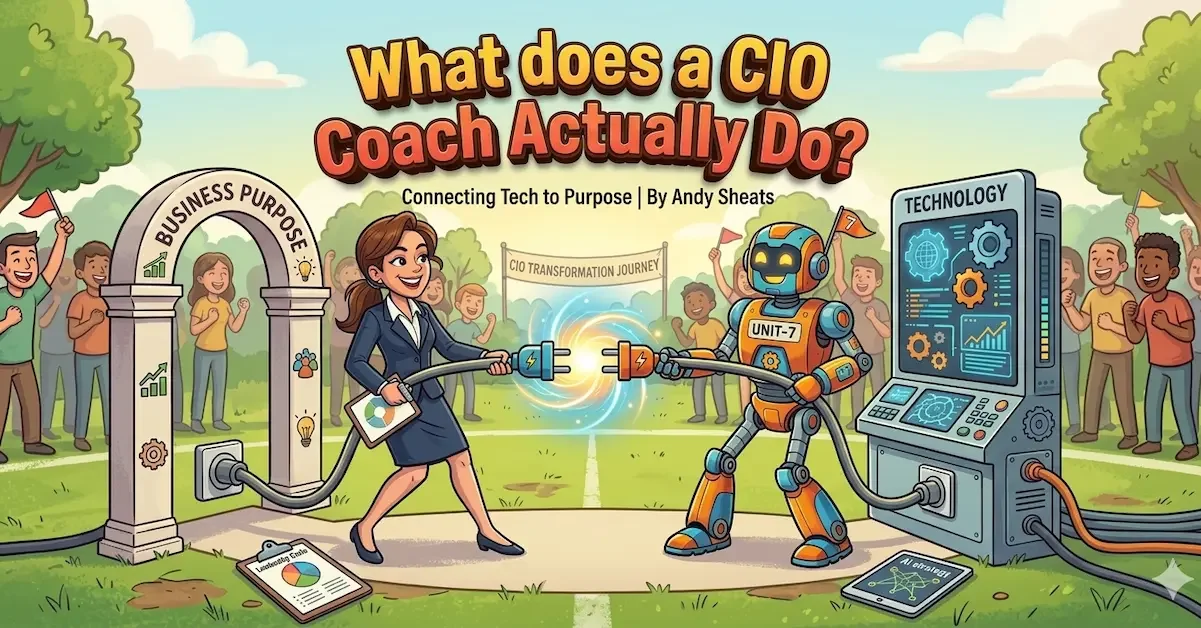
We worked on how she could become the connector — the person who tied the organisation's technology capabilities to its purpose and its broader strategic ambitions. How to bring the scattered AI initiatives into a coherent narrative. How to bring her executive peers along with her, rather than positioning it as a technology play they didn't own.
The shift wasn't in her technical knowledge. She already had that. The shift was in how she saw her own contribution — and how she started showing up in the conversations that mattered. Ultimately, she will be the person calling those meetings.
What CIO Coaching Is Not
It's worth being direct about this, because there are misconceptions.
It's not me writing your strategy. You have one. What coaching does is help you connect it to the organisation's purpose — and to the broader purpose of what you're building in Australia and around the world. That connection is what gets people to follow.
It's not about fixing technical gaps. Every CIO I've worked with is technically competent. That is not where they need help. They need help getting traction — with their board, with their executive peers, with their own team. That's a leadership question, not a technical one.
It's not therapy. Some people do need therapy; coaching is not a substitute. It's rigorous, outcomes-focused work with specific targets. We measure progress. We know what success looks like at the end.
It's not a quick fix. The engagements I run are typically six to twelve months. Real change in leadership behaviour takes time. The magic doesn't happen when I'm in the room. It comes in the a-ha moment when a CIO connects the conversations we've been having to a real situation — and the cog of transformation turns. The CIOs who get the most out of it are the ones who arrive knowing that — and commit to the process.
The Thing Most CIOs Actually Need
Every CIO I know is technically capable. Most are working incredibly hard. What they consistently need help with is not more knowledge — it's a lift in the leadership.
Lift in how they connect technology to what the organisation is trying to become. Lift in how they engage the board, the CEO, their executive peers who don't fully understand what technology makes possible, their tech leadership team, and Lift in how they connect every member of their team to a clear priority and a genuine sense of contribution.
The CIOs who operate at that level don't just deliver technology. They shape strategy. The refactor organisation and organisational constructs. They build the kind of team that people want to work in. They become the executive that the CEO relies on to see around corners.
That's what CIO coaching is for. That's what we're building.
If you're wondering whether this kind of work is right for you, I'm happy to have that conversation. No pitch — just a discussion.
About Andy Sheats
Andy Sheats coaches CIOs, CTOs, and senior technology leaders. He has led digital businesses for 30 years as CEO, founder, CTO, investor, and director.
As CTO at Open Universities Australia he modernised engineering culture and doubled team throughput. As CEO and co-founder of health.com.au he raised $85m, grew to $120m in revenue, and was named Growth CEO of the Year by AVCAL. At REA Group he led global strategy through mergers and acquisitions, growing shareholder value by 10x.
Andy holds an MBA from Melbourne Business School, a Graduate Diploma from AICD, and is an accredited Leadership Circle Profile practitioner. He limits his practice to six clients at any one time.
Read Andy's full story → | CIO Coaching → | Book a discovery call →